The Human Design Throat Center in Children
Understanding Expression, Communication, and the Voice of Your Child
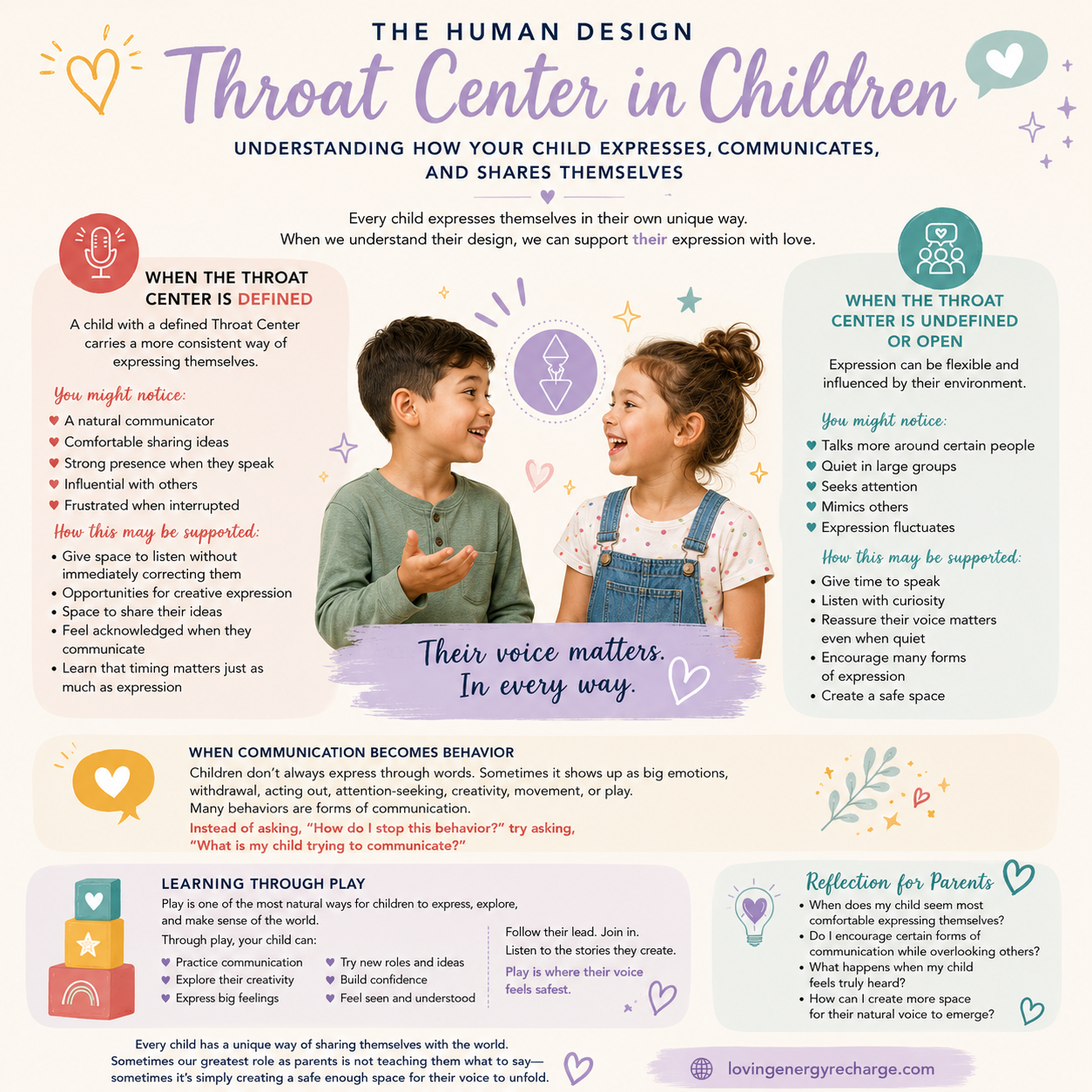
One of the greatest gifts we can offer our children is the experience of feeling heard. Not simply listened to, but truly heard. To feel that their thoughts matter, their feelings matter, and that there is space for them to express themselves in a way that feels natural and authentic to who they are.
As parents, it can be easy to focus on what our children are saying—or not saying. We may find ourselves wondering why one child talks endlessly while another remains quiet. Why one child eagerly shares every detail of their day while another needs time before opening up. We may celebrate children who are confident communicators while worrying about those who appear shy, withdrawn, or hesitant to speak.
Human Design offers a different perspective. Rather than viewing communication as a skill that every child should express in the same way, it invites us to recognize that each child has their own unique relationship with expression. Some communicate through words. Others through movement, creativity, music, storytelling, play, imagination, or simply through their presence.
The Throat Center provides insight into how a child may naturally express themselves and how their energy moves into the world. Understanding this center is not about changing how your child communicates. It is about becoming curious about the way their voice is already trying to emerge.
What Does the Throat Center Represent?
The Throat Center is often associated with communication, but its role extends far beyond speaking. In Human Design, the Throat Center is the center of expression, manifestation, creativity, and visibility. It is where inner energy finds a pathway into the outer world.
For children, this may show up through the way they communicate, tell stories, express emotions, share ideas, ask questions, create, sing, perform, imagine, or engage with others. Some children express themselves through conversation, while others communicate most clearly through art, movement, play, or observation.
The Throat Center reminds us that expression takes many forms. A child who rarely speaks may still be communicating constantly through their actions, creativity, body language, and energy. Learning to recognize these different forms of expression can help us better understand what our children are trying to share with us.
When the Throat Center Is Defined
Children with a defined Throat Center tend to carry a more consistent way of expressing themselves. This does not necessarily mean they are outgoing or talkative. Rather, there is often a reliability in how their voice and expression move through the world.
You may notice that your child naturally shares ideas, enjoys telling stories, or expresses themselves with confidence when they feel comfortable. Their communication style may feel recognizable and consistent regardless of where they are or who they are with. Some children with a defined Throat may have a strong presence that others notice, even when they are not speaking very much.
A child with a defined Throat Center may become frustrated when they feel interrupted, ignored, or unable to express what they are trying to communicate. Their voice often feels like an important part of who they are.
This might look like the child who narrates everything they are doing, loves performing for family members, naturally leads conversations among friends, or eagerly shares new ideas and discoveries. It may also show up as a child who has a strong need to speak when inspiration strikes.
These children are often supported by opportunities for creative expression and by environments where they feel genuinely listened to. Giving space to listen without immediately correcting them can help build trust in their voice and confidence in their ability to communicate. They often thrive when they feel their ideas are welcomed and their expression is valued.
When the Throat Center Is Undefined or Open
Children with an undefined or open Throat Center often experience expression differently. Rather than carrying a consistent way of communicating, they tend to be more sensitive to the communication styles and energies around them.
You may notice that your child appears very talkative in one environment and much quieter in another. Around certain people they may seem confident and expressive, while in unfamiliar situations they may become reserved or withdrawn. Neither experience is more authentic than the other. Their expression is simply influenced by what they are sensing around them.
Some children with an undefined Throat may occasionally interrupt conversations or seek attention in ways that appear unexpected. Often this is not because they are trying to dominate the conversation. Instead, there can be an underlying fear that if they do not speak now, they may not have another opportunity to be heard.
These children are often learning that they do not need to compete for attention in order for their voice to matter.
Supporting an undefined Throat Center begins with creating safe opportunities for expression without pressure. They benefit from being invited into conversations rather than being put on the spot. They often flourish when adults approach them with curiosity rather than expectation and allow communication to emerge naturally in its own timing.
Just as importantly, they benefit from understanding that their value is not determined by how much they speak. Their voice matters whether they are talking, creating, observing, or simply being present.
When Communication Becomes Behavior
Children do not always communicate through words. Sometimes communication arrives through big emotions. Sometimes it appears as withdrawal, frustration, silliness, attention-seeking, creativity, resistance, or tears.
Many behaviors that challenge us as parents are often attempts at communication. A child who is constantly interrupting may be asking to feel seen. A child who becomes quiet may be processing something they do not yet have words for. A child who acts out may be communicating an unmet need, overwhelm, or emotional experience that feels too large to express directly.
When we begin viewing behavior as communication, we naturally become more curious and less reactive. Instead of asking, "How do I stop this behavior?" we begin asking, "What is my child trying to tell me?" That single shift can change the entire relationship.
Learning Through Play
Play is one of the most natural ways children discover and develop their voice. When expression is connected to curiosity, creativity, and enjoyment, children often communicate more freely than when they feel pressure to perform or explain themselves. Through play, they experiment with ideas, emotions, imagination, and relationships in ways that help them better understand themselves and the world around them.
Some children may express themselves through storytelling, creating elaborate adventures and imaginary worlds. Others may find their voice through music, movement, building, drawing, role-playing, or dramatic play. What matters most is not the activity itself but the opportunity for authentic expression.
As parents, we do not need to teach our children how to express themselves as much as we need to create environments where expression feels safe. Play naturally becomes one of those environments.
When children are given freedom to explore, imagine, create, and communicate without fear of being wrong, their confidence often begins to grow alongside their voice.
The Gifts Within the Throat Center
While the Throat Center represents expression as a whole, the individual gates within the center offer additional insight into the unique qualities of a child's voice.
Each gate carries its own gift, perspective, and way of communicating. Some children are storytellers. Some are leaders. Some are innovators. Some are here to simplify ideas, while others inspire through their creativity or emotional expression.
These gates do not determine who your child will become. Rather, they offer clues about the natural qualities that may already be seeking expression through them.
Gate 62 — The Voice of Details
Children with Gate 62 often notice the little things that others miss. They may be naturally curious about how things work, enjoy explaining information, or ask questions that reveal their attention to detail.
You may find yourself smiling as they carefully describe every part of a story, explain the rules of a game, or share facts they have learned. These children often feel more confident when they understand something clearly and can communicate it in a way that makes sense.
Supporting this energy may look like encouraging their curiosity, answering questions when possible, and giving them opportunities to explore subjects that genuinely interest them. Building projects, puzzles, science activities, and hands-on learning often provide wonderful outlets for this gift.
Gate 23 — The Voice of Simplicity
Children with Gate 23 often see the world differently. They may arrive at conclusions that seem unexpected or offer observations that make adults stop and think. What appears unusual at first often carries a surprising amount of wisdom beneath it.
These children are natural innovators. They frequently process information in unique ways and may need time before sharing their thoughts. When they do speak, they often have an ability to simplify complex ideas into something surprisingly easy to understand.
As parents, it can be helpful to resist the urge to immediately correct or dismiss ideas that seem unusual. Some of their greatest gifts emerge when they are given permission to think differently and trust their own perspective.
Gate 56 — The Storyteller
Children carrying Gate 56 often experience life through stories, imagination, and adventure. They may eagerly share what happened during their day, create elaborate imaginary worlds, or transform everyday experiences into exciting tales. Storytelling becomes one of the ways they process life and make meaning of their experiences.
These children often learn best through experience rather than instruction alone. They may be drawn to books, dramatic play, role-playing, creative writing, or sharing stories with friends and family. When supported, this gift can develop into a beautiful ability to inspire, teach, and connect with others through the power of storytelling.
Gate 35 — The Adventurer
Children with Gate 35 are often curious about what comes next. There is frequently a desire for new experiences, exploration, and discovery. These children may become restless when life feels too repetitive or predictable for long periods of time.
They often learn through doing rather than observing. New activities, places, friendships, hobbies, and experiences help them gather wisdom about themselves and the world around them.
As parents, providing healthy opportunities for exploration can help satisfy this natural curiosity. Not every adventure needs to be big. Sometimes trying a new food, visiting a new park, or learning a new skill is enough to support this energy.
Gate 12 — The Voice of Emotional Expression
Children with Gate 12 often have a deep connection between their emotions and their expression. There may be times when they have a great deal to say and other times when they prefer silence. Their communication is often influenced by how emotionally safe they feel in the moment.
These children can be highly sensitive to tone, energy, and the emotional atmosphere around them. They may pick up on what others are feeling long before anyone speaks about it.
Supporting this gift often involves honoring their emotional timing. They may not always be ready to talk immediately, and that is okay. Giving them space to process their feelings can help them find their voice naturally.
Gate 45 — The Voice of Gathering Together
Children with Gate 45 often have a natural awareness of groups and community. You may notice them organizing games, bringing friends together, or naturally stepping into leadership roles during play. There is often a desire to contribute, share, and create experiences where everyone feels included.
This energy is not about controlling others. At its healthiest, it is about stewardship, responsibility, and creating a sense of belonging. Providing opportunities for collaboration, teamwork, and leadership can help these children develop confidence while learning how to support others.
Gate 33 — The Voice of Reflection
Children with Gate 33 often need time to process their experiences before talking about them. While some children share immediately, these children may revisit experiences internally first. They often learn through reflection and may return to a conversation days later with new insights and understanding.
You might notice a love of memories, keepsakes, photographs, journaling, or revisiting meaningful experiences. Supporting this gift often means respecting their need for privacy and understanding that silence is not always avoidance. Sometimes silence is simply where wisdom is forming.
Gate 8 — The Voice of Contribution
Children with Gate 8 often have a strong sense of individuality. They are frequently drawn toward expressing themselves in unique ways and may naturally inspire others simply by being themselves. These children often resist fitting into molds that do not feel authentic to them.
You may notice creativity, originality, and a desire to do things differently. Whether through art, fashion, music, leadership, or personal interests, they are often searching for ways to contribute something meaningful to the world around them.
These children thrive when their individuality is celebrated rather than corrected.
Gate 31 — The Voice of Leadership
Children with Gate 31 often possess a natural ability to influence others through their words. Rather than forcing their way forward, their leadership tends to emerge when others trust and respect them. Friends may naturally seek their opinions, and they may often find themselves speaking on behalf of a group.
These children frequently have a strong sense of fairness and can become passionate about helping others feel included or heard. Supporting this energy means helping them understand that true leadership is not about being in charge. It is about listening, serving, and using their voice responsibly.
Gate 20 — The Voice of the Present Moment
Children with Gate 20 often live very much in the now. What they notice, feel, and experience tends to emerge immediately. Their observations can feel spontaneous, insightful, and surprisingly honest. These children often remind adults of something we easily forget—that life is happening right now.
They may be highly aware of what is occurring around them, quick to respond to experiences, and naturally connected to the present moment. While this can sometimes appear impulsive, it also carries tremendous wisdom.
Supporting this gift often involves helping them remain connected to their awareness while teaching healthy ways to express what they notice and experience. For these children, life is not something that happens later. Life is happening now.
Reflection for Parents
As you reflect on your child's relationship with communication and expression, consider:
When does my child seem most comfortable expressing themselves?
What forms of communication come naturally to them?
How do I respond when my child communicates differently than I expect?
Are there ways my child expresses themselves that I may be overlooking?
How can I create more space for their unique voice to emerge?
Every Child Has a Voice Worth Hearing
One child may express themselves through endless questions. Another through stories. Another through art, movement, imagination, leadership, or quiet observation. The purpose of understanding your child's Throat Center is not to place them into a category or predict who they will become. It is an invitation to become curious. To notice. To listen.
Some children need encouragement to speak. Some need permission to pause. Some need reassurance that they do not need to compete to be heard. Others simply need the freedom to express themselves in their own unique way.
When children feel safe to communicate without judgment, correction, or pressure, they begin developing something far more valuable than confidence. They begin developing trust in themselves. And that trust becomes the foundation from which their authentic voice can emerge throughout their lives.
Much Love,
Lisa Richard
Important Note
This article was created with the support of artificial intelligence (ChatGPT) and reviewed as part of the Children Feel Energy Too educational series. The information shared is intended for educational, self-awareness, and personal reflection purposes only. Human Design is not a diagnostic, medical, psychological, or therapeutic system and should not be used as a substitute for professional advice, diagnosis, or treatment.
Every child is unique. Parents, caregivers, and educators are encouraged to use discretion when interpreting the information provided and to consider the individual needs, experiences, and developmental stage of each child. If you have concerns regarding your child's emotional, mental, physical, behavioral, or developmental well-being, please consult with a qualified healthcare professional, pediatrician, psychologist, counselor, or other licensed practitioner.

About Lisa Richard
Lisa Richard is a Human Design Guide, certified Reiki Master Teacher, Emotion Code Practitioner, Ancestral Healer, Lightworker Coach, Intuitive Channel, and Oracle Card Reader with a passion for helping individuals better understand themselves and the unique way they experience the world.
Married to her soulmate over 29 years, Lisa is the proud mother of three adult daughters and grandmother to two young grandchildren. Her experiences as both a parent and grandparent continue to deepen her appreciation for the individuality, sensitivity, and natural wisdom that children carry.
Through her work with Human Design, Lisa helps parents gain a deeper understanding of their child's unique energetic makeup, strengths, sensitivities, learning style, and emotional needs. She believes that when children feel seen, understood, and supported for who they naturally are, they develop greater confidence, self-awareness, and trust in themselves.
Lisa's approach blends intuitive insight with practical guidance, creating a compassionate space for self-discovery, growth, and deeper connection between parents and their children.
To explore Human Design readings, personalized child and family sessions, energy healing services, courses, workshops, and other offerings, please visit our website. We would be honored to support you on your journey of self-discovery, healing, and deeper understanding.
Visit: lovingenergyrecharge.com
