The Human Design Ajna Center in Children
Understanding Perspectives, Learning Styles, and the Need for Certainty
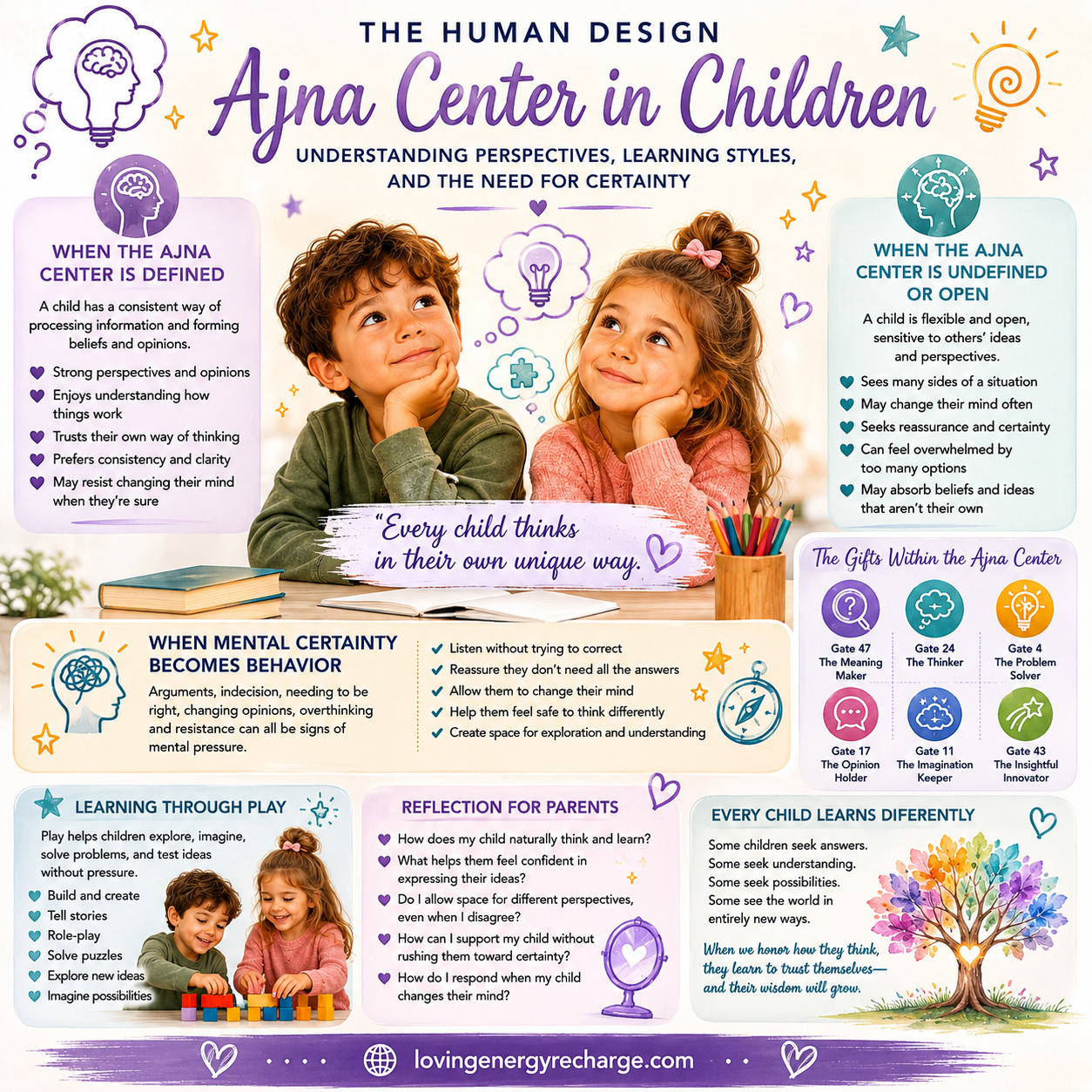
Every child sees the world differently. Some children need time to think before responding. Some seem to have strong opinions from an early age. Others constantly imagine new possibilities, while some prefer predictable answers and clear explanations.
As parents, we often focus on what our children are learning, but we don't always stop to consider how they are learning.
Why does one child need every detail explained?
Why does another child seem comfortable with uncertainty?
Why does one child change their mind easily while another holds tightly to their perspective?
The Ajna Center offers us a compassionate way to understand how our children process information, develop beliefs, form opinions, and make sense of the world around them.
Rather than determining intelligence, the Ajna Center speaks to something much deeper: the way a child organizes their thoughts and creates meaning from their experiences.
Understanding this center can help us move away from trying to make our children think a certain way and instead support the unique way their minds are naturally designed to learn, understand, and grow.
What Does the Ajna Center Represent?
The Ajna Center is the center of mental processing, conceptualization, beliefs, opinions, and understanding. While the Head Center asks questions, the Ajna Center seeks to make sense of them.
This is the part of a child's design that helps them organize information, create understanding, form perspectives, and develop their own way of seeing the world. For some children, this may show up as strong opinions, curiosity about how things work, or a desire for consistency and understanding. For others, it may appear as flexibility, openness, and an ability to see multiple perspectives at once.
The Ajna Center reminds us that there is no single "right" way to think. Each child is developing their own relationship with learning, certainty, and understanding. And sometimes the greatest gift we can offer is allowing them the freedom to arrive at their own conclusions.
When the Ajna Center Is Defined
Children with a defined Ajna Center often have a more consistent way of processing information and understanding the world around them. They may naturally develop strong perspectives, enjoy learning about subjects that interest them, or feel comforted by having a clear understanding of how things work.
These children often trust their own thinking process. Once they have formed an understanding, they may be less likely to change their minds simply because someone else thinks differently. This can sometimes appear as confidence and certainty. Other times it may look like stubbornness.
You may notice a child who enjoys sharing their opinions, explaining their reasoning, or wanting others to understand their perspective. They often appreciate consistency and may become frustrated when information feels confusing, contradictory, or unclear.
Supporting a defined Ajna often means respecting their process. They do not necessarily need to be convinced or corrected. Instead, they benefit from conversations that encourage exploration while honoring the way they naturally think and learn.
When the Ajna Center Is Undefined or Open
Children with an undefined Ajna Center often experience thinking in a more flexible and adaptive way. Rather than being attached to a single perspective, they may naturally see multiple viewpoints and understand situations from many different angles. These children can be incredibly open-minded and perceptive.
At times, however, this openness can create pressure to find certainty. You may notice them changing their opinions frequently, seeking reassurance about whether they are "right," or feeling overwhelmed when faced with too many perspectives at once.
Because they are sensitive to the beliefs and ideas of others, they may sometimes adopt viewpoints that do not truly belong to them. One day they may feel certain about something, and the next day they may feel completely unsure.
This is not confusion. It is often the natural flexibility of an open mind.
Supporting these children involves helping them understand that they do not need to have everything figured out. They do not need to rush toward certainty. Sometimes wisdom comes from remaining open to possibilities.
When Mental Certainty Becomes Behavior
Children are constantly trying to make sense of the world around them. As they learn, grow, and gather new experiences, they naturally begin forming opinions, beliefs, ideas, and perspectives. Most of the time this process unfolds quietly in the background. Sometimes, however, the pressure to understand, be certain, or make sense of things can begin showing up through behavior.
A child with a defined Ajna Center may become frustrated when others challenge their understanding or perspective. They may argue their point, insist they are right, or become resistant when asked to consider another viewpoint. While this can sometimes appear stubborn, it is often a reflection of how consistently they process information and how much trust they place in their own understanding.
A child with an undefined Ajna Center may experience something different. They may change their mind frequently, struggle with decision-making, seek constant reassurance, or become overwhelmed when faced with too many possibilities. They may worry about making the wrong choice or feel pressure to figure out the "right" answer before moving forward.
As parents, it can be easy to focus on the behavior itself.
The arguing.
The indecision.
The need to be right.
The constant changing of opinions.
Yet beneath these behaviors is often a child who is simply trying to understand the world in the best way they know how.
Sometimes they need reassurance that it is okay to think differently than others.
Sometimes they need permission to change their mind.
Sometimes they need to learn that not every question has a single right answer.
And sometimes they simply need to feel heard.
When we begin viewing these behaviors as part of a child's learning process rather than something that needs to be fixed, we create space for greater understanding and self-trust to develop.
Learning Through Play
The Ajna Center loves exploration, imagination, creativity, and understanding. Children naturally develop their thinking skills through play long before they develop them through formal learning. Play allows them to test ideas, explore possibilities, solve problems, imagine new worlds, and experiment with different perspectives.
Some children may enjoy building elaborate creations and figuring out how things work. Others may become absorbed in storytelling, puzzles, pretend play, art, strategy games, or activities that encourage imagination and problem-solving.
Children with strong Ajna energy often enjoy asking questions during play. They may create complex rules for games, invent new systems, or explore endless "what if" scenarios.
Children with an open Ajna often benefit from play that allows flexibility and creativity. Activities without a single right answer can help them learn that multiple perspectives and possibilities can coexist.
The goal is not to teach children what to think. The goal is to support their natural curiosity and help them develop confidence in how they think.
When children feel safe exploring ideas without fear of being wrong, they begin developing trust in their own understanding.
The Gifts Within the Ajna Center
While the Ajna Center represents understanding as a whole, the gates within the center offer additional insight into the unique ways a child's mind may process information and create meaning.
Some children are natural visionaries. Some are deep thinkers. Some are problem solvers. Some are imaginative dreamers. Others bring entirely new perspectives that challenge what has always been accepted.
Each gate offers a unique gift that can help parents better understand how their child naturally learns and makes sense of the world.
Gate 47 — The Meaning Maker
Children with Gate 47 often spend time trying to make sense of their experiences. Their minds naturally look for understanding, patterns, and meaning. They may revisit events, ask thoughtful questions, or spend time reflecting on situations long after they have happened.
Sometimes these children may become frustrated when things feel confusing or when understanding does not arrive immediately. Yet their gift lies in their ability to eventually transform confusion into clarity.
You may notice a child who enjoys reflecting, telling stories about experiences, or piecing together information over time. They often discover understanding when they are given space to process rather than pressure to figure things out quickly.
Supporting this gift often means allowing them time to think and trusting that clarity will emerge when they are ready.
Gate 24 — The Thinker
Children with Gate 24 often return to the same thoughts and questions repeatedly. Their minds naturally revisit ideas in an attempt to deepen understanding. They may ask the same question multiple times, replay situations in their minds, or become fascinated by a particular topic for long periods of time. While adults may sometimes see this as overthinking, it is often part of how these children process information.
These children benefit from patience and opportunities to explore their interests deeply. They often gain confidence when they are allowed to think things through at their own pace rather than being rushed toward conclusions.
Gate 4 — The Problem Solver
Children with Gate 4 naturally look for answers. When they encounter a problem, their minds immediately begin searching for solutions. They may enjoy puzzles, strategy games, building projects, and activities that require logical thinking.
These children often feel most comfortable when things make sense.
At times, they may become frustrated when answers are unavailable or when situations feel uncertain. Learning that some questions take time to answer can be an important part of their growth.
Supporting this gift often means encouraging curiosity while helping them understand that not every problem requires an immediate solution.
Gate 17 — The Opinion Holder
Children with Gate 17 often develop strong opinions and perspectives. They naturally observe patterns, form conclusions, and enjoy sharing their thoughts about what they notice. These children may confidently explain how they think something should be done or why they believe a particular approach makes sense.
Their opinions are not usually about being right. Rather, they are part of how these children engage with and understand the world around them.
Supporting this gift means encouraging respectful conversations while helping them remain open to the perspectives of others.
Gate 11 — The Imagination Keeper
Children with Gate 11 often possess rich inner worlds filled with ideas, possibilities, and imagination. Their minds may be constantly generating images, stories, concepts, and creative visions. They are often dreamers who enjoy imagining what could be rather than focusing solely on what is.
You may notice a child who loves storytelling, drawing, creating imaginary worlds, or sharing ideas that seem to come from nowhere.
These children often flourish when given opportunities for creative expression. Their imagination is not a distraction from reality—it is one of their greatest gifts.
Gate 43 — The Insightful Innovator
Children with Gate 43 often see things differently than those around them. They may arrive at conclusions others have not considered or offer perspectives that seem unusual at first. Their insights often emerge suddenly and can be surprisingly profound.
Sometimes these children may feel misunderstood because their ideas do not always fit within conventional ways of thinking. Yet their gift lies in their ability to bring something new.
Supporting this energy often involves encouraging their individuality and helping them trust their unique way of seeing the world, even when others do not immediately understand it.
Reflection for Parents
As you reflect on your child's relationship with learning, understanding, and perspective, consider:
How does my child naturally process information?
Does my child seek certainty or feel comfortable exploring possibilities?
How do I respond when my child thinks differently than I do?
What environments help my child feel most confident in expressing their ideas?
How can I create more space for curiosity, imagination, and open exploration?
Every Child Learns Differently
Some children seek answers. Some seek understanding. Some seek possibilities. Some seek entirely new ways of seeing the world. The purpose of understanding your child's Ajna Center is not to determine whether their thinking is right or wrong. It is an invitation to recognize that every child learns, processes, and understands life in their own unique way.
Some children need support trusting their perspective.
Some need reassurance that they do not have to know everything.
Some need permission to change their minds.
And some need the freedom to imagine possibilities that others cannot yet see.
When children learn that their way of thinking is valued, they begin developing trust in themselves. And from that trust, wisdom naturally begins to grow.
Much Love,
Lisa Richard
Important Note
This article was created with the support of artificial intelligence (ChatGPT) and reviewed as part of the Children Feel Energy Too educational series. The information shared is intended for educational, self-awareness, and personal reflection purposes only. Human Design is not a diagnostic, medical, psychological, or therapeutic system and should not be used as a substitute for professional advice, diagnosis, or treatment.
Every child is unique. Parents, caregivers, and educators are encouraged to use discretion when interpreting the information provided and to consider the individual needs, experiences, and developmental stage of each child. If you have concerns regarding your child's emotional, mental, physical, behavioral, or developmental well-being, please consult with a qualified healthcare professional, pediatrician, psychologist, counselor, or other licensed practitioner.

About Lisa Richard
Lisa Richard is a Human Design Guide, certified Reiki Master Teacher, Emotion Code Practitioner, Ancestral Healer, Lightworker Coach, Intuitive Channel, and Oracle Card Reader with a passion for helping individuals better understand themselves and the unique way they experience the world.
Married to her soulmate over 29 years, Lisa is the proud mother of three adult daughters and grandmother to two young grandchildren. Her experiences as both a parent and grandparent continue to deepen her appreciation for the individuality, sensitivity, and natural wisdom that children carry.
Through her work with Human Design, Lisa helps parents gain a deeper understanding of their child's unique energetic makeup, strengths, sensitivities, learning style, and emotional needs. She believes that when children feel seen, understood, and supported for who they naturally are, they develop greater confidence, self-awareness, and trust in themselves.
Lisa's approach blends intuitive insight with practical guidance, creating a compassionate space for self-discovery, growth, and deeper connection between parents and their children.
To explore Human Design readings, personalized child and family sessions, energy healing services, courses, workshops, and other offerings, please visit our website. We would be honored to support you on your journey of self-discovery, healing, and deeper understanding.
Visit: lovingenergyrecharge.com
