The Human Design Heart Center in Children
Understanding Self-Worth, Commitment, Motivation, and Personal Value
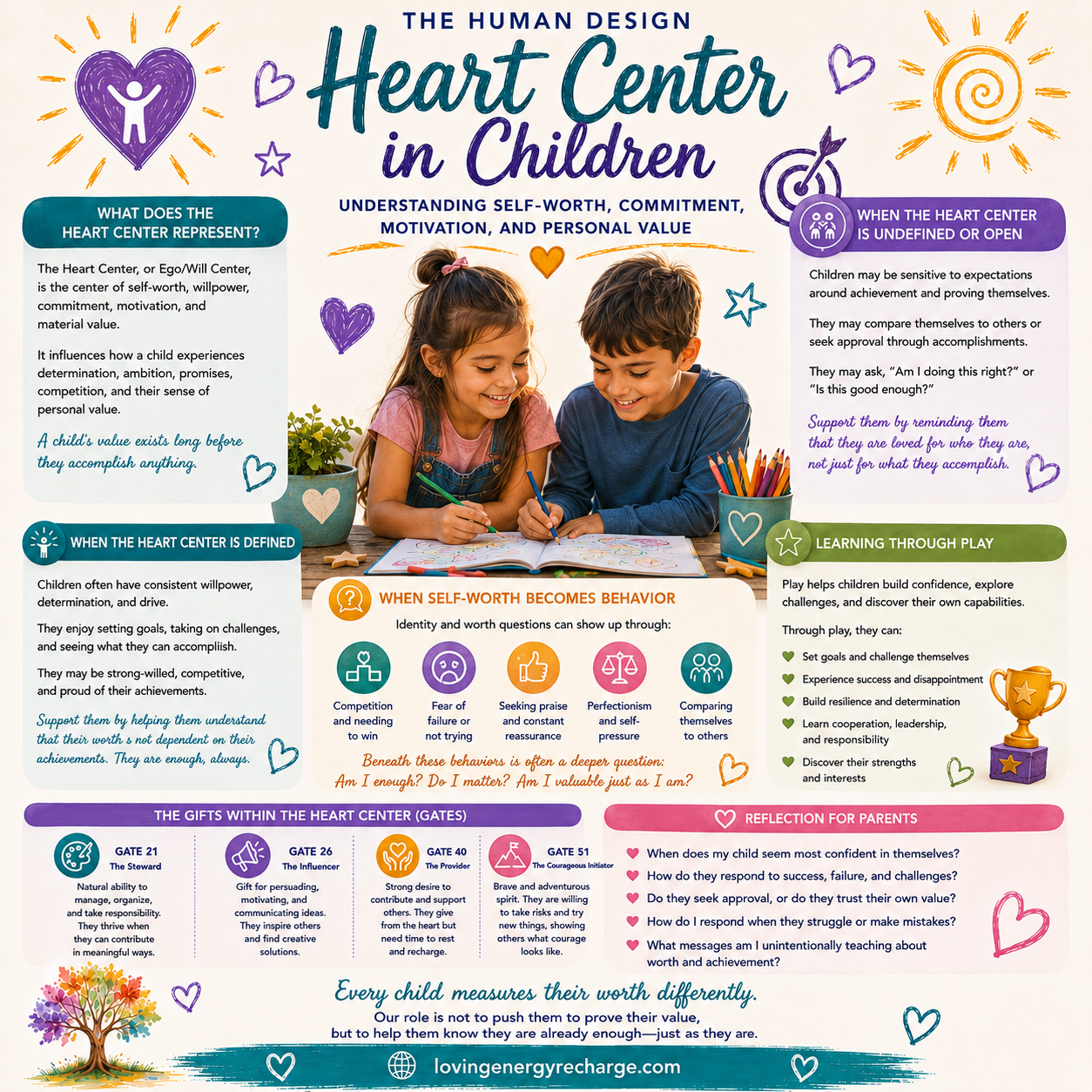
One of the greatest gifts we can offer our children is helping them understand that their worth is not something they need to earn. Yet many children grow up in environments that unintentionally teach the opposite. They learn to seek approval through achievement, compare themselves to others, or believe their value comes from what they accomplish rather than who they are.
As parents, we often witness this in small moments.
A child who proudly announces, "Look what I did!"
A child who becomes discouraged when they cannot do something perfectly.
A child who constantly compares themselves to siblings, classmates, or friends.
A child who works tirelessly to prove themselves.
A child who gives up before trying because they are afraid of failing.
Through the lens of Human Design, the Heart Center offers a compassionate way of understanding how a child experiences self-worth, motivation, commitment, and personal value.
This center is not about confidence in the traditional sense. It is about a child's relationship with worth.
How they measure themselves.
What motivates them.
How they make promises to themselves and others.
And whether they believe they need to prove something in order to be loved, valued, or accepted.
Understanding this center helps us move away from rewarding children solely for what they do and toward helping them recognize the value of who they already are.
What Does the Heart Center Represent?
The Heart Center, sometimes called the Ego or Will Center in Human Design, is the center of self-worth, willpower, commitment, motivation, and material value.
This center influences how a child experiences determination, ambition, promises, competition, and their sense of personal value. It also plays a role in how they navigate goals, commitments, and the expectations they place upon themselves.
Some children naturally have access to consistent willpower and motivation. Others experience these qualities more inconsistently and may not be designed to push themselves in the same way. Neither experience is better than the other.
The Heart Center reminds us that worth is not measured by productivity, achievement, success, or how hard someone works. A child's value exists long before they accomplish anything. When we understand this center, we begin supporting children in building a healthy relationship with commitment, confidence, and self-esteem without tying their worth to performance.
When the Heart Center Is Defined
Children with a defined Heart Center often carry a more consistent relationship with determination and willpower. These children may enjoy setting goals, taking on challenges, competing, or proving to themselves that they can accomplish something meaningful. When they commit to something, they often have the energy to follow through.
You may notice a child who is naturally motivated when they care about something. They often enjoy the satisfaction that comes from reaching a goal, completing a project, or demonstrating what they are capable of doing. At times, they may appear strong-willed, independent, or highly competitive. They may enjoy testing themselves and seeing what they can accomplish through effort and determination.
Supporting these children often means helping them understand that their worth is not dependent on their achievements. While their drive is a gift, they benefit from learning that they are valuable whether they succeed, fail, win, or lose.
When their natural determination is balanced with self-acceptance, they often develop healthy confidence and resilience.
When the Heart Center Is Undefined or Open
Children with an undefined or open Heart Center often experience self-worth differently. Rather than carrying consistent access to willpower, they may be deeply sensitive to expectations around achievement, success, and proving themselves.
These children can sometimes compare themselves to others or feel pressure to demonstrate their value through accomplishments. They may work very hard to gain approval or become discouraged when they feel they are not measuring up.
You may notice a child who frequently seeks reassurance, asks whether they did a good job, or becomes upset when they cannot achieve something immediately. Beneath these behaviors is often a desire to know that they are already enough. Because they are sensitive to the expectations around them, they may sometimes push themselves beyond their natural limits in an effort to prove their worth.
Supporting these children begins with helping them separate their value from their performance. They benefit from hearing that they are loved for who they are, not simply for what they accomplish.
When children with an undefined Heart Center learn that they do not need to prove themselves, they often develop a healthier relationship with both achievement and self-esteem.
When Self-Worth Becomes Behavior
Children do not always express concerns about self-worth through words. Sometimes those concerns appear through behavior. A child may become highly competitive and struggle when they lose. Another may avoid trying new things because they are afraid of failure. Some children may constantly seek praise and reassurance, while others become perfectionistic and place enormous pressure on themselves.
You may notice a child who becomes frustrated when they cannot master something quickly. Another may compare themselves to siblings or friends and feel discouraged when they believe they fall short. Beneath many of these behaviors is often a deeper question. Am I enough? Do I matter? Am I valuable even if I don't succeed? These are deeply human questions that every child encounters in some form.
When we begin viewing these behaviors through the lens of self-worth rather than simply behavior management, we create opportunities for greater understanding and connection. Sometimes children do not need more encouragement to achieve. Sometimes they need reassurance that they are already worthy.
Learning Through Play
Play offers children a safe environment to explore challenges, develop confidence, and learn about their own capabilities. Through games, creative projects, sports, imaginative play, and hands-on experiences, children naturally discover what they enjoy, where they feel successful, and how they respond to both accomplishment and disappointment.
Children with strong Heart Center energy often enjoy activities that allow them to set goals, challenge themselves, and experience the satisfaction of improvement. They may enjoy building something, mastering a skill, or working toward a personal achievement.
Children with an undefined Heart Center often benefit from play environments that emphasize enjoyment over performance. Activities that encourage exploration, creativity, cooperation, and self-expression can help them develop confidence without feeling pressure to prove themselves.
The goal is not to help children become the best. The goal is to help them recognize their value regardless of the outcome.
The Gifts Within the Heart Center
While the Heart Center represents self-worth and willpower as a whole, the gates within this center offer additional insight into the unique ways a child may experience motivation, value, courage, and commitment.
Each gate carries its own gift and expression.
Gate 21 — The Steward
Children with Gate 21 often enjoy feeling capable and responsible. They may naturally want to organize, help, manage tasks, or feel a sense of ownership over their responsibilities.
These children often thrive when they are given opportunities to contribute in meaningful ways. Supporting this gift means allowing them to develop responsibility while also teaching them that they do not need to control everything in order to feel secure.
Gate 26 — The Influencer
Children with Gate 26 often have a natural ability to persuade, motivate, and influence others. They may be excellent storytellers, negotiators, or communicators who know how to share their ideas in engaging ways. These children often enjoy connecting with others and finding creative solutions to challenges.
Supporting this gift means helping them use their influence with integrity and authenticity.
Gate 40 — The Provider
Children with Gate 40 often have a strong desire to contribute and support those they care about. They may naturally enjoy helping, sharing, or doing things that benefit their family and community. At the same time, they often need periods of rest and independence to recharge.
Supporting this gift means helping them understand that caring for themselves is just as important as caring for others.
Gate 51 — The Courageous Initiator
Children with Gate 51 often possess a courageous and adventurous spirit. They may enjoy trying new things, stepping into unfamiliar situations, or challenging themselves in ways that help them grow. These children often teach others about bravery simply through their willingness to take risks.
Supporting this gift means encouraging healthy courage while helping them understand that bravery is not the absence of fear—it is moving forward despite it.
Reflection for Parents
As you reflect on your child's relationship with self-worth, commitment, and confidence, consider:
When does my child seem most confident in themselves?
How do they respond to success, failure, and challenges?
Do they seek approval, or do they trust their own value?
How do I respond when they struggle or make mistakes?
What messages am I unintentionally teaching about worth and achievement?
Every Child Experiences Their Worth Differently
Some children are naturally driven.
Some are naturally competitive.
Some seek achievement.
Some seek reassurance.
Some need reminders that they do not have to prove anything at all.
The purpose of understanding your child's Heart Center is not to determine how successful they will become. It is to help them develop a healthy relationship with their own value.
When children learn that their worth is not something they need to earn, they begin building confidence from a much deeper place. A place that is not dependent on achievements, accomplishments, trophies, grades, or approval. A place rooted in the simple truth that they are already enough. And from that foundation, healthy confidence naturally begins to grow.
Much Love,
Lisa Richard
Important Note
This article was created with the support of artificial intelligence (ChatGPT) and reviewed as part of the Children Feel Energy Too educational series. The information shared is intended for educational, self-awareness, and personal reflection purposes only. Human Design is not a diagnostic, medical, psychological, or therapeutic system and should not be used as a substitute for professional advice, diagnosis, or treatment.
Every child is unique. Parents, caregivers, and educators are encouraged to use discretion when interpreting the information provided and to consider the individual needs, experiences, and developmental stage of each child. If you have concerns regarding your child's emotional, mental, physical, behavioral, or developmental well-being, please consult with a qualified healthcare professional, pediatrician, psychologist, counselor, or other licensed practitioner.

About Lisa Richard
Lisa Richard is a Human Design Guide, certified Reiki Master Teacher, Emotion Code Practitioner, Ancestral Healer, Lightworker Coach, Intuitive Channel, and Oracle Card Reader with a passion for helping individuals better understand themselves and the unique way they experience the world.
Married to her soulmate over 29 years, Lisa is the proud mother of three adult daughters and grandmother to two young grandchildren. Her experiences as both a parent and grandparent continue to deepen her appreciation for the individuality, sensitivity, and natural wisdom that children carry.
Through her work with Human Design, Lisa helps parents gain a deeper understanding of their child's unique energetic makeup, strengths, sensitivities, learning style, and emotional needs. She believes that when children feel seen, understood, and supported for who they naturally are, they develop greater confidence, self-awareness, and trust in themselves.
Lisa's approach blends intuitive insight with practical guidance, creating a compassionate space for self-discovery, growth, and deeper connection between parents and their children.
To explore Human Design readings, personalized child and family sessions, energy healing services, courses, workshops, and other offerings, please visit our website. We would be honored to support you on your journey of self-discovery, healing, and deeper understanding.
Visit: lovingenergyrecharge.com
