The Human Design Head Center in Children
Understanding Inspiration, Curiosity, and Mental Pressure
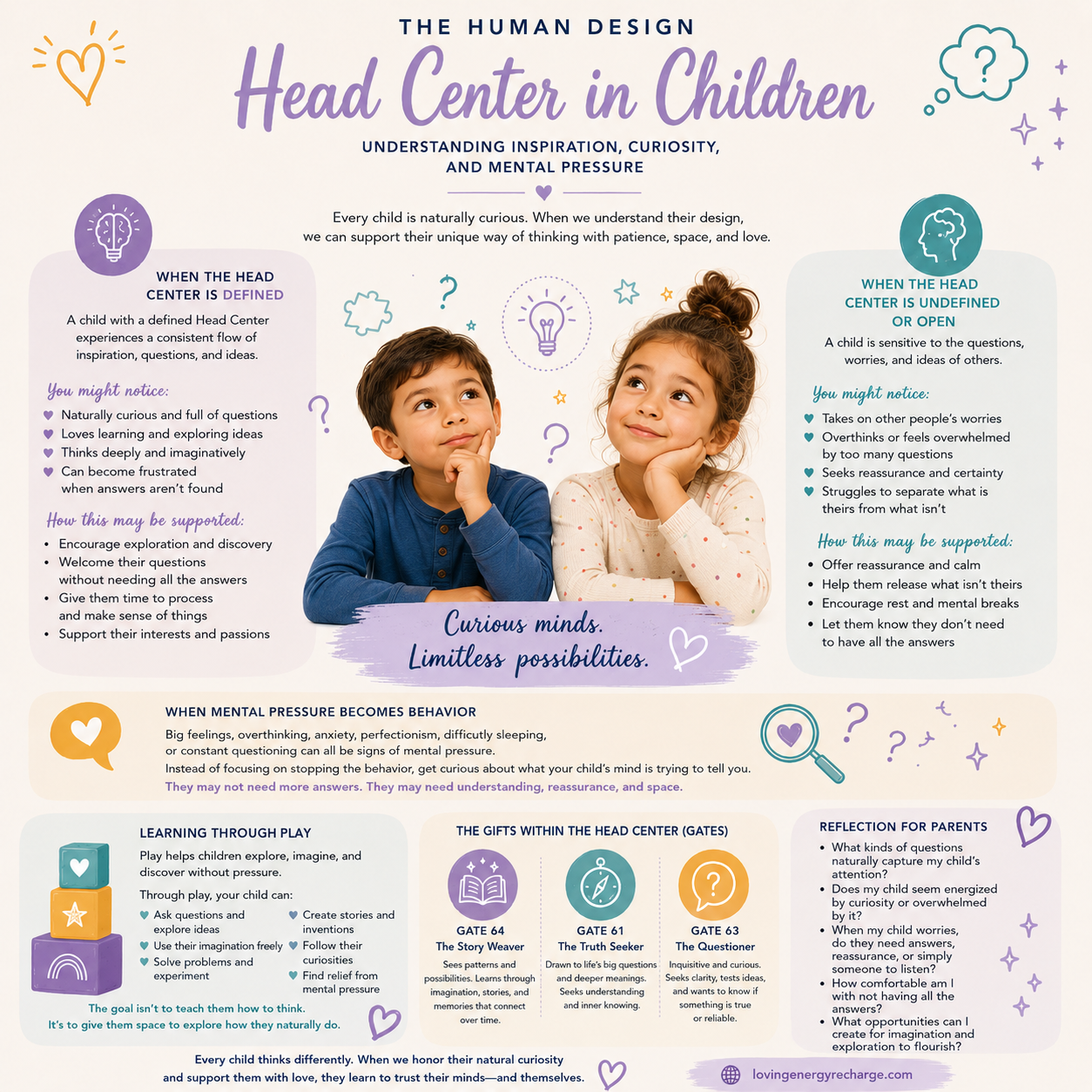
Children are naturally curious. From the moment they begin exploring the world, they ask questions, observe patterns, imagine possibilities, and try to make sense of what they see around them. Some children seem to have an endless stream of questions. Others spend long periods quietly observing before sharing their thoughts. Some are constantly imagining new possibilities, while others seek certainty and reassurance before moving forward.
As parents, it can sometimes feel like we are expected to have all the answers.
Why are they asking so many questions?
Why do they worry about things that haven't happened?
Why do they seem lost in their imagination?
Why do they overthink simple decisions?
Through the lens of Human Design, the Head Center offers a compassionate way of understanding how a child experiences inspiration, curiosity, questions, and mental pressure.
Rather than focusing on what a child is thinking, the Head Center invites us to become curious about how they think and what may be influencing the questions moving through their mind.
Understanding this center is not about controlling a child's thoughts or providing every answer. It is about recognizing the unique way their mind engages with life and learning how to support them as they discover their own relationship with curiosity, uncertainty, and wonder.
What Does the Head Center Represent?
The Head Center is the center of inspiration, questions, curiosity, imagination, and mental pressure. In Human Design, this center is often associated with the questions that capture our attention and the inspiration that sparks new ideas. It is not a center designed to provide answers. Instead, it is a center that encourages exploration, contemplation, and discovery.
For children, this may show up as endless questions, vivid imagination, creative thinking, curiosity about how things work, or a desire to understand the world around them. Some children may seem naturally inspired by ideas and possibilities, while others may feel pressure to figure things out or make sense of experiences that feel confusing.
The Head Center reminds us that curiosity is not a problem to solve. It is a natural part of growth and learning. Children are not meant to have all the answers. They are meant to explore, question, imagine, and discover.
When the Head Center Is Defined
Children with a defined Head Center tend to experience inspiration in a more consistent way. There is often a reliable stream of ideas, questions, and mental activity moving through them.
These children may seem naturally curious and thoughtful. They often enjoy exploring ideas, solving problems, learning new things, or asking questions that lead to deeper conversations. Their minds may be active and engaged much of the time.
You may notice that your child frequently thinks about possibilities, enjoys understanding how things work, or becomes deeply interested in subjects that capture their attention. They often carry a steady source of inspiration within themselves and may return to the same questions repeatedly as they continue exploring and learning.
At times, these children may become frustrated when they cannot immediately find answers or when others dismiss their curiosity. Their questions are often part of how they learn and process the world around them.
Supporting a defined Head Center is often less about providing answers and more about encouraging exploration. Creating opportunities for curiosity, imagination, learning, and discovery helps these children trust their natural way of engaging with life.
When the Head Center Is Undefined or Open
Children with an undefined or open Head Center often experience inspiration differently.
Rather than generating a consistent stream of mental pressure from within, they tend to be highly sensitive to the questions, worries, ideas, and expectations of the people around them.
These children may pick up on concerns that are not actually their own. They may begin worrying about things that someone else is worried about or become preoccupied with questions they never considered until they encountered them in their environment.
Because of this sensitivity, some children with an undefined Head Center may feel pressure to find answers for everyone, solve problems that are not theirs, or carry concerns beyond their years.
You may notice periods where they seem overwhelmed by choices, worries, questions, or information. At times, they may struggle to separate what they are genuinely curious about from what they have absorbed from the people around them.
Supporting these children often begins with reassurance. They do not need to solve every problem. They do not need to answer every question. And they are not responsible for carrying the worries of the world around them.
When given permission to release what isn't theirs, these children often develop tremendous wisdom, empathy, and perspective.
When Mental Pressure Becomes Behavior
Children do not always have the words to explain what is happening in their minds. Sometimes mental pressure shows up through behavior long before it is ever expressed through conversation.
A child carrying a great deal of mental pressure may ask the same question repeatedly, even after receiving an answer. Another child may become stuck in worry about something that hasn't happened. Some children may struggle to fall asleep because their minds continue exploring ideas, possibilities, and questions long after their bodies are tired.
Others may appear distracted, overwhelmed, anxious, perfectionistic, or frustrated when they cannot immediately understand something.
As parents, it can be tempting to assume these behaviors need to be fixed. Yet often they are invitations to become curious about what is happening beneath the surface.
The child who asks endless questions may not actually be searching for answers. They may be seeking reassurance, connection, or simply exploring their curiosity.
The child who worries about every possibility may not need someone to solve the problem. They may need help feeling safe enough to release a question that has become stuck in their mind.
The child who constantly seeks certainty may be learning how to trust themselves when life feels uncertain.
When we begin viewing these behaviors through the lens of understanding rather than correction, we create space for children to develop a healthier relationship with their own minds.
Sometimes the most supportive thing we can offer is not another answer. Sometimes it is helping them recognize that not every question requires an immediate solution.
Learning Through Play
The Head Center thrives through curiosity, imagination, exploration, and discovery. Children naturally learn through asking questions and exploring possibilities. Play provides a safe environment where they can experiment with ideas without pressure to get everything right.
Some children may enjoy creating imaginary worlds filled with endless possibilities. Others may love solving puzzles, building inventions, conducting experiments, or exploring nature with a sense of wonder. Many children with active Head Center energy are less interested in finding the "right" answer and more interested in discovering what might be possible.
Open-ended play can be especially supportive because it encourages curiosity without requiring certainty. Building forts, creating stories, exploring nature, inventing games, asking "what if" questions, and engaging in imaginative play all help children develop confidence in their own thinking process.
For children experiencing mental pressure, play also offers something equally important: relief.
When children become absorbed in creativity, movement, exploration, and imagination, they often step out of the need to figure everything out. They return to the present moment and reconnect with the natural joy of discovery.
The goal is not to teach children how to think. The goal is to create opportunities for them to explore, question, imagine, and trust the unique way their minds engage with the world.
The Gifts Within the Head Center
While the Head Center represents inspiration and mental pressure as a whole, the gates within this center offer additional insight into the unique ways a child's curiosity may express itself.
Some children are natural dreamers. Some are seekers of truth. Some are questioners who challenge assumptions and encourage deeper understanding. Each gate offers a different doorway into learning, curiosity, and inspiration.
Gate 64 — The Story Weaver
Children with Gate 64 often experience life through images, memories, imagination, and patterns.
Their minds may naturally gather pieces of information that do not immediately seem connected. At times, they may appear lost in thought or immersed in their own inner world. They may tell stories, revisit memories, or ask questions that seem unrelated until a larger picture eventually begins to emerge.
These children often learn by allowing experiences to settle over time rather than demanding immediate understanding. What may initially appear confusing often becomes meaningful later.
You may notice a vivid imagination, rich dreams, creativity, or a fascination with stories and symbolism. These children often enjoy books, art, storytelling, and activities that allow their imagination to roam freely.
Supporting this gift often means allowing them time. They do not always need immediate answers. Sometimes they simply need space for understanding to unfold naturally.
Gate 61 — The Inner Truth Seeker
Children with Gate 61 are often drawn toward life's deeper questions. Even at a young age, they may wonder about things that seem surprisingly profound. Questions about meaning, purpose, spirituality, life, death, the universe, or the nature of reality may emerge naturally for them. These children are not simply gathering information. They are searching for understanding.
There is often a deep inner knowing moving within them, even if they cannot fully explain it. They may spend time reflecting quietly, exploring ideas independently, or contemplating questions that other children have never considered.
At times, they may become frustrated when answers feel incomplete or when others dismiss their curiosity. Supporting this gift involves honoring their questions without feeling responsible for providing every answer. Sometimes the greatest gift we can offer these children is the freedom to wonder.
Not every mystery needs to be solved. Some are meant to be explored.
Gate 63 — The Questioner
Children with Gate 63 often possess a naturally inquisitive mind. They may question information, test ideas, and seek reassurance before accepting something as true. These children are often trying to understand whether something is reliable, trustworthy, or accurate.
To adults, this can sometimes look like skepticism, doubt, or endless questioning. Yet beneath the questions is often a desire for clarity. These children are learning how to discern what feels true for them.
You may notice them asking "Why?" repeatedly, challenging assumptions, or wanting to understand how something works before they feel comfortable accepting it. While this can occasionally feel exhausting as a parent, it is also one of their greatest strengths. Their questions help them develop critical thinking, discernment, and wisdom.
Supporting this gift means welcoming curiosity rather than viewing it as opposition. The goal is not to stop the questions. The goal is to help them trust their ability to explore them.
Reflection for Parents
As you reflect on your child's relationship with curiosity, inspiration, and mental pressure, consider:
What kinds of questions seem to naturally capture my child's attention?
Does my child appear energized by curiosity or overwhelmed by it?
When my child worries, do they need answers, reassurance, or simply someone to listen?
How comfortable am I with not having all the answers to my child's questions?
What opportunities can I create for imagination, wonder, and exploration to flourish?
Every Child Thinks Differently
Some children explore the world through imagination. Some through questions. Some through deep reflection. Some through curiosity that never seems to stop.
The purpose of understanding your child's Head Center is not to label how they think or determine how intelligent they are. It is an invitation to recognize the unique way inspiration moves through them.
Some children need support trusting their ideas.
Some need reassurance that they do not need to solve every problem.
Some need permission to ask questions without fear of being wrong.
And some simply need space to wonder.
When children learn that curiosity is welcome, questions are safe, and uncertainty is a natural part of learning, they begin developing a healthy relationship with their own minds. They discover that they do not need to know everything. They simply need to remain open to learning. And from that openness, wisdom naturally begins to grow.
Much Love,
Lisa Richard
Important Note
This article was created with the support of artificial intelligence (ChatGPT) and reviewed as part of the Children Feel Energy Too educational series. The information shared is intended for educational, self-awareness, and personal reflection purposes only. Human Design is not a diagnostic, medical, psychological, or therapeutic system and should not be used as a substitute for professional advice, diagnosis, or treatment.
Every child is unique. Parents, caregivers, and educators are encouraged to use discretion when interpreting the information provided and to consider the individual needs, experiences, and developmental stage of each child. If you have concerns regarding your child's emotional, mental, physical, behavioral, or developmental well-being, please consult with a qualified healthcare professional, pediatrician, psychologist, counselor, or other licensed practitioner.

About Lisa Richard
Lisa Richard is a Human Design Guide, certified Reiki Master Teacher, Emotion Code Practitioner, Ancestral Healer, Lightworker Coach, Intuitive Channel, and Oracle Card Reader with a passion for helping individuals better understand themselves and the unique way they experience the world.
Married to her soulmate over 29 years, Lisa is the proud mother of three adult daughters and grandmother to two young grandchildren. Her experiences as both a parent and grandparent continue to deepen her appreciation for the individuality, sensitivity, and natural wisdom that children carry.
Through her work with Human Design, Lisa helps parents gain a deeper understanding of their child's unique energetic makeup, strengths, sensitivities, learning style, and emotional needs. She believes that when children feel seen, understood, and supported for who they naturally are, they develop greater confidence, self-awareness, and trust in themselves.
Lisa's approach blends intuitive insight with practical guidance, creating a compassionate space for self-discovery, growth, and deeper connection between parents and their children.
To explore Human Design readings, personalized child and family sessions, energy healing services, courses, workshops, and other offerings, please visit our website. We would be honored to support you on your journey of self-discovery, healing, and deeper understanding.
Visit: lovingenergyrecharge.com
