The Human Design Splenic Center in Children
Understanding Intuition, Safety, Sensitivity, Health, and Inner Knowing
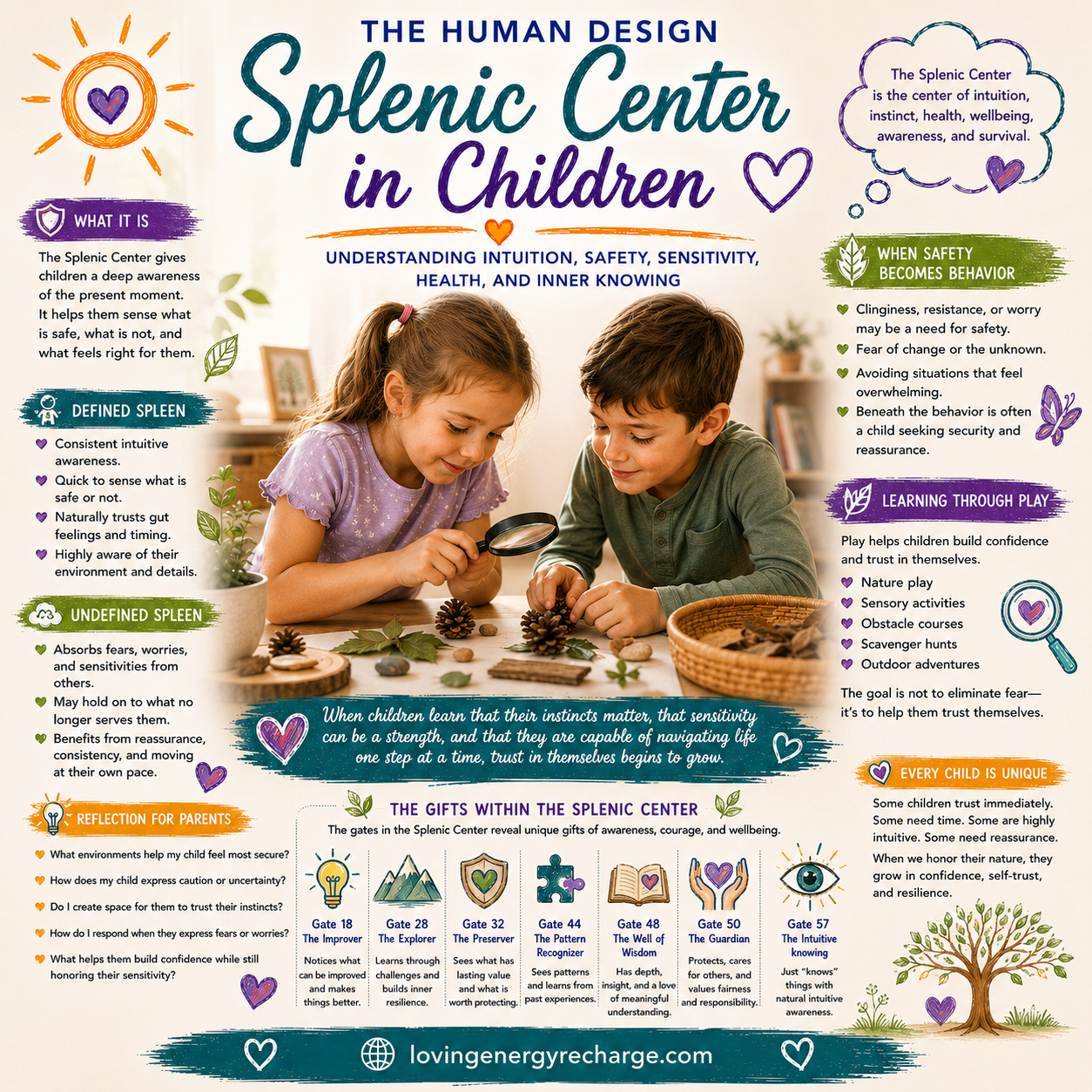
The Splenic Center is often one of the most misunderstood centers in Human Design, especially when it comes to children.
Many of the qualities associated with the Spleen can easily be mistaken for anxiety, shyness, caution, sensitivity, clinginess, or fear. Yet beneath many of these behaviors is often a child whose body is naturally paying attention to the world around them.
Some children seem to know things before they can explain them. They may instantly sense when something feels safe or unsafe, comfortable or uncomfortable, aligned or misaligned. Others appear highly aware of their environment, noticing changes, sounds, moods, and details that many people overlook.
As parents, we may find ourselves wondering why one child needs extra reassurance before trying something new while another jumps in without hesitation. Why one child seems deeply affected by loud environments, unfamiliar situations, or changes in routine. Why they sometimes resist things that appear perfectly safe from an adult perspective.
Through the lens of Human Design, the Splenic Center offers a compassionate way of understanding a child's instincts, intuition, sensitivities, awareness, and relationship with safety.
Rather than viewing sensitivity as weakness or fear as something that needs to be eliminated, this center invites us to recognize the wisdom that can exist within a child's natural awareness.
Understanding this center is not about teaching children to ignore their instincts. It is about helping them learn when to trust them. When children learn to listen to the quiet wisdom of their bodies, they often develop greater confidence, self-trust, and resilience.
What Does the Splenic Center Represent?
The Splenic Center is the center of intuition, instinct, health, wellbeing, awareness, and survival. This center influences how a child experiences safety, responds to their environment, and receives intuitive information in the present moment.
Unlike emotions, which often move in waves, Splenic awareness tends to be immediate. It can show up as a subtle feeling, a quiet knowing, a physical response, or an instinctive awareness that something feels right—or doesn't. Children often experience this naturally. A child may immediately know whether they feel comfortable around someone. They may sense when they need rest. They may become aware of changes in their environment long before others notice them.
The Splenic Center reminds us that the body carries its own wisdom. Sometimes children are listening to that wisdom long before they have words to explain it.
When the Splenic Center Is Defined
Children with a defined Splenic Center often have a consistent relationship with their instincts and intuitive awareness. These children may naturally trust their gut feelings and often experience immediate knowing in certain situations. They may be highly aware of their surroundings and quick to recognize what feels safe, healthy, or supportive for them.
You may notice a child who instinctively avoids situations that feel uncomfortable or who seems unusually aware of subtle details others miss. These children often have an innate sense of timing and may know when something feels right without needing extensive explanation. At times, adults may question their reactions because the child cannot always explain why they feel the way they do. Yet their bodies are often communicating important information.
Supporting these children means helping them trust their instincts while also learning to distinguish between intuition and fear. When children with a defined Spleen learn to honor their inner knowing, they often develop remarkable self-trust and awareness.
When the Splenic Center Is Undefined or Open
Children with an undefined or open Splenic Center often experience sensitivity differently. Rather than generating consistent instinctive awareness, they tend to amplify and absorb information from their environment. These children may become highly aware of fears, worries, sensitivities, or discomforts around them. They may hold onto things that no longer serve them because letting go feels uncertain.
At times, they may appear cautious, hesitant, or overly concerned about safety. Because they are amplifying Splenic energy, fears can sometimes feel larger than they actually are. You may notice a child who struggles with change, worries about trying new things, or feels attached to familiar people, places, or routines.
Supporting these children often means helping them develop confidence in themselves while gently encouraging healthy exploration. They benefit from reassurance, consistency, and learning that growth can happen safely.
When children with an undefined Spleen learn to recognize what truly belongs to them, they often develop tremendous compassion, awareness, and sensitivity.
When Safety Becomes Behavior
Children do not always communicate their need for safety directly. Sometimes their relationship with safety shows up through behavior. A child may cling to a parent before entering a new environment. Another may resist change or become upset when routines shift unexpectedly. Some children may avoid situations that feel overwhelming, while others become hyper-aware of potential risks. At times, what appears to be stubbornness, avoidance, or anxiety may actually be a child trying to create a sense of safety.
When we begin looking beneath the behavior, we often discover a child seeking reassurance, predictability, or support. Instead of asking, "Why are they afraid?" We might ask, "What would help them feel safe?" That question often changes everything.
Learning Through Play
Play helps children develop confidence in themselves and their relationship with the world around them. Through exploration, movement, imaginative play, nature experiences, sensory activities, and age-appropriate challenges, children gradually learn what feels safe and what they are capable of navigating.
Children with strong Splenic awareness often enjoy opportunities to explore independently while remaining connected to a sense of security.
Children with an undefined Spleen often benefit from gentle encouragement that allows them to move at their own pace.
Nature play, obstacle courses, sensory bins, scavenger hunts, outdoor adventures, and activities that engage the senses can be particularly supportive. The goal is not to eliminate fear. The goal is to help children develop trust in themselves.
The Gifts Within the Splenic Center
While the Splenic Center represents intuition and awareness as a whole, the gates within this center offer additional insight into the unique ways a child may experience instinct, sensitivity, courage, and wellbeing.
Gate 18 — The Improver
Children with Gate 18 naturally notice what could be improved. They often see details others miss and may enjoy helping make things work better.
Gate 28 — The Courageous Explorer
Children with Gate 28 often learn through challenges and experiences that help them discover their inner strength and resilience.
Gate 32 — The Preserver
Children with Gate 32 often possess an awareness of what has lasting value. They may naturally recognize what is worth nurturing and protecting.
Gate 44 — The Pattern Recognizer
Children with Gate 44 often notice patterns in people, situations, and experiences. They may have a remarkable ability to learn from past experiences.
Gate 48 — The Well of Wisdom
Children with Gate 48 often possess natural depth and insight. They may enjoy learning deeply about subjects that interest them.
Gate 50 — The Guardian
Children with Gate 50 often care deeply about responsibility, fairness, and protecting those they love. They may naturally take on nurturing roles.
Gate 57 — The Intuitive Knowing
Children with Gate 57 often possess strong intuitive awareness. They may simply "know" things without understanding how they know them.
Reflection for Parents
As you reflect on your child's relationship with intuition, sensitivity, and safety, consider:
What environments help my child feel most secure?
How does my child express caution or uncertainty?
Do I create space for them to trust their instincts?
How do I respond when they express fears or worries?
What helps them build confidence while still honoring their sensitivity?
Every Child Experiences Safety Differently
Some children trust immediately.
Some need time.
Some rely on their instincts.
Some seek reassurance.
Some learn through cautious observation.
Some learn through exploration.
The purpose of understanding your child's Splenic Center is not to remove fear or sensitivity. It is to recognize the wisdom that can exist within them.
When children learn that their instincts matter, that sensitivity can be a strength, and that they are capable of navigating life one step at a time, they begin developing something incredibly valuable. Trust in themselves. And from that trust, courage naturally begins to grow.
Much Love,
Lisa Richard
Important Note
This article was created with the support of artificial intelligence (ChatGPT) and reviewed as part of the Children Feel Energy Too educational series. The information shared is intended for educational, self-awareness, and personal reflection purposes only. Human Design is not a diagnostic, medical, psychological, or therapeutic system and should not be used as a substitute for professional advice, diagnosis, or treatment.
Every child is unique. Parents, caregivers, and educators are encouraged to use discretion when interpreting the information provided and to consider the individual needs, experiences, and developmental stage of each child. If you have concerns regarding your child's emotional, mental, physical, behavioral, or developmental well-being, please consult with a qualified healthcare professional, pediatrician, psychologist, counselor, or other licensed practitioner.

About Lisa Richard
Lisa Richard is a Human Design Guide, certified Reiki Master Teacher, Emotion Code Practitioner, Ancestral Healer, Lightworker Coach, Intuitive Channel, and Oracle Card Reader with a passion for helping individuals better understand themselves and the unique way they experience the world.
Married to her soulmate over 29 years, Lisa is the proud mother of three adult daughters and grandmother to two young grandchildren. Her experiences as both a parent and grandparent continue to deepen her appreciation for the individuality, sensitivity, and natural wisdom that children carry.
Through her work with Human Design, Lisa helps parents gain a deeper understanding of their child's unique energetic makeup, strengths, sensitivities, learning style, and emotional needs. She believes that when children feel seen, understood, and supported for who they naturally are, they develop greater confidence, self-awareness, and trust in themselves.
Lisa's approach blends intuitive insight with practical guidance, creating a compassionate space for self-discovery, growth, and deeper connection between parents and their children.
To explore Human Design readings, personalized child and family sessions, energy healing services, courses, workshops, and other offerings, please visit our website. We would be honored to support you on your journey of self-discovery, healing, and deeper understanding.
Visit: lovingenergyrecharge.com
